Tag: wayfinding

  • night-time navigation

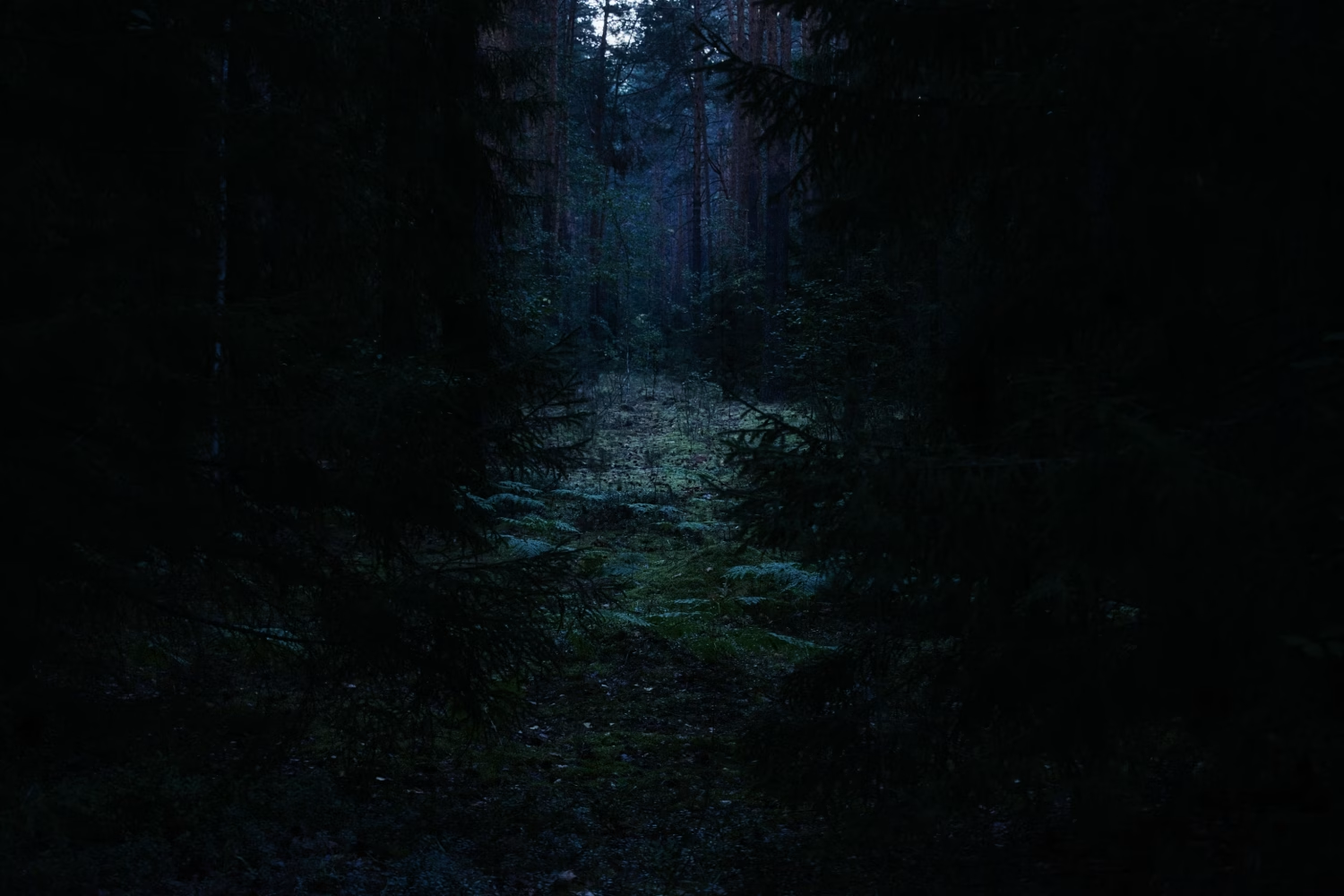
    night-time navigation

    For a few months now, I have practiced being lost, both metaphorically and literally. I have practiced being in-between-things, I have practiced waiting for signs, I have practiced not knowing what is next. I gave up a job, I finished a book and I made space for something else to enter my life. Whatever it is, the something else has not yet arrived.

    The bridge between an old life and a new life is the present. Or, as a card in my living room reminds me daily: ‘You are not lost, you are here’. In my better moments, I wonder if what I’m practicing right now might serve me in the years to come. 

    For over a month now, the poem ‘We grow accustomed to the Dark’ by Emily Dickinson has been on my mind. And yes, it’s a little on the nose to write about darkness only days after one the biggest power outages in Europe’s history but here we are. In the first two stanzas, Dickinson describes a person walking home from a neighbor’s house in the pitch-black night, trying to see the road ahead. Slowly, the eyes get used to the absence of light. All good, then? Almost, Dickinson says. This is how the poem continues:

    And so of larger—Darknesses—
    Those Evenings of the Brain—
    When not a Moon disclose a sign—
    Or Star—come out—within—

    The Bravest—grope a little—
    And sometimes hit a Tree
    Directly in the Forehead—
    But as they learn to see—

    Either the Darkness alters—
    Or something in the sight
    Adjusts itself to Midnight—
    And Life steps almost straight.

    Walking home alone in the dark, the wanderer has space and time to contemplate larger ‘Darknesses’. Everything unsolved, unanswered and uncertain suddenly keeps her company. I have felt like that more times than I can count. But what comforts me about Dickinson’s poem is the way I can read it as an instruction manual for ‘Those Evenings of the Brain’. It’s okay to move forward when you can’t see a thing, Dickinson says. It’s okay to stretch out your hands and be clumsy. If you move, you will ‘sometimes hit a Tree’ but remember that your bruises are not mistakes; they are evidence of bravery, of having tried. As you rub your sore forehead, take comfort in knowing that you ‘learn to see’.

    The Darkness of this poem is not the darkness of depression, nor the darkness of death. If anything, this Darkness has the texture of black velvet: it’s not a threat. We can be okay in its company, Dickinson says, though she puts it far more beautifully in the poem’s final line. And in one cheeky move she also reminds us that, for all our bruises and our learning and our night-time navigating, we were never in control: it is ‘Life’ stepping almost straight. All this time, as we walked through the dark, we were in relationship with a force far larger than us. Invisible, almost, to our daytime sight.

    This is an essay from my newsletter The Star Container, first published in April 2025. Subscribe or head to the archive here.

  • the practice of self-trust

    the practice of self-trust

    About twelve years ago, when I was going through a difficult time, I had dinner with a good friend. I don’t know why,’ my friend said, ‘but I think you should meet my colleague M. She does these meditation evenings at her house. It could be your thing.’

    I texted M. and started going to her meditation evenings once a month. For the first five or six times, I wasn’t sure it was my thing – there was no big neon sign saying YES, DO IT when I took the train to her house – but I went anyway. I always felt calm afterwards.

    We sat on pillows on the floor in a small room in M’s flat. If there were more than five of us, our knees touched. We always sat in a circle; a candle burning in the middle. After the meditation, M. often invited us to practice other things as well. Once, we did an exercise where we held the hands of the person next to us and were instructed to tell that person everything we saw before our inner eye. ‘It doesn’t need to make sense,’ M. reminded us. ‘Just try and find words for what comes up.’ That evening, the person whose hands I held grew emotional when I told her what I saw. ‘You are perfectly describing what I feel, Lena. Thank you.’ But how?, I wondered.

    Another time, M. gave us crayons and paper and told us to imagine our future and draw the first image that appeared in our minds. I produced a wonky sketch of a house bordering on an ocean, with mountains rising behind it. I will live there, I thought, and immediately wondered where the thought had come from. I had no such plans! But three years later, without me ‘planning it’ at all, I moved from Switzerland to New Zealand and lived in a house by the ocean with mountains rising behind it. That exercise, and hindsight, taught me that intuition is funny and magical and not always useful in the present. But it’s not useless, either.

    “Red Path, St. Prex” by Alexei von Jawlensky, painted in 1915 (Public Domain)

    One evening, in summer, two people canceled at the last minute and I was the only one who showed up at M’s place. ‘Let’s go for a walk,’ she said. I was glad to be outside; I had been feeling sad and stuck for months. I just couldn’t figure out what to do with my life and I punished myself for it. I told M. as much. There was a stretch of forest behind her house. The grass was high and the last light of the day was golden. We walked for a while without talking. Then she stopped, her chin slightly up. I followed her gaze and saw a squirrel in a tree. ‘Is that squirrel telling you something?’ she asked. No one in my life had ever asked me such a question. But I had been in the meditation group long enough to remember that I wasn’t supposed to give ‘the right answer’, I could simply wait for whatever came up. I never felt silly in M. presence.

    ‘I think perhaps the squirrel is telling me to let go a little. To relax. But that –’

    ‘It doesn’t need to make sense,’ M. said.

    And we walked on, all the way back home.

    I’ve been wanting to write about self-trust for a while and never found the words. Then I started wondering about my teachers and M.’s face appeared, her thick head of hair, her glowing brown eyes. It took me years to understand her lessons, to let them become a part of me. She helped me come to my senses. She gently insisted that I take my intuition seriously, that I practice and stumble and return to this terrain far beyond where things make sense. There’s a path there. ‘It is made by walking’, as the Spanish poet Antonio Machado wrote. M. also taught me, in her own strange way, to love my mistakes and let them become part of my self-trust. Our entire life is a practice of having to make decisions about things we know so little about. I expect I’ll still get things ‘wrong’ in the days before my death. But that doesn’t mean I don’t trust my intuition.

    I listen to all kinds of animals now, squirrels included, and I listen to trees and rivers too. When I feel a small whisper inside to go somewhere or talk to someone, I do it. Not always immediately. Often, the whisper will ‘follow’ me around for weeks, even months, before I finally give in. The practice of trusting myself is ongoing. I’m slowly learning that my ‘self’ is woven into everything around me, that my life is dependent on each tree, river and squirrel who crosses my path. No earth, air or water? No self. I guess my self-trust is only as good as the trust I put into all that I’m sharing this earth with.

    So, if a bird, cat, fox or squirrel happens to cross your path, why not ask them if they have a message for you? Why not ask the flowering fruit trees in your backyard, too?

    In other words, why not trust and see what happens?

    This is an essay from my newsletter The Star Container, first published in April 2025. Subscribe or head to the archive here.

  • the ones who don’t answer you

    the ones who don’t answer you

    A few days ago, I sat in a bright community hall with a view of a bay, surrounded by about forty strangers. I was on Iona, a small island off the west coast of Scotland, listening to the Irish poet Pádraig Ó Tuama talk about survival through the lens of beauty. Every day, he’d read us a poem, say, by Lucille Clifton, or Marie Howe, or Dunya Mikhail and we’d talk about it: how it moved us, the questions it raised. From that, we’d write our own poems, the first scraps. And as the sky outside changed, we began to share what we wrote. Over the span of a few days, we covered it all: death, loss, silence, conflict, heartache. I wouldn’t say it was fun, exactly. But there’s something to be said for being in community with a group of kind-hearted people and talk about the things that really matter, the things that gnaw at your soul.

    On the morning of our fourth day together, Pádraig stood in the same sunlit spot he had stood in all week and gave us another sharp question:

    Who in your life doesn’t answer you?

    The day’s topic was ‘Desire’ and here we were, being thrown right into it. We were asked to ponder our one-way streets, those we have with the living and the dead and our pets and god and maybe famous people. I thought about writers I admire and the imaginary conversations I have with them. I thought about former lovers, things left unsaid. I thought about teachers, mentors, people I haven’t seen in years. And soon, my head was filled with both the feeling of want and the feeling of shame, and rejection. That awful sensation when you send a message to someone you really like and they leave you on read, forever.

    We were instructed to choose one person from our desire-list and write them a series of postcards. We were instructed to be confident and honest. Strangely, doing this made the desire easier to bear. Here are some postcards I wrote to a meditation teacher I found online a few years ago. We’ve never met. I talk to her all the time in my head. I’ll call her ‘Josephine’.

    Josephine,

    Is it ok that I’m still

    at the very beginning?

    The pages gather dust.

    Josephine,

    I haven’t meditated for three days.

    I don’t even miss it.

    Instead, I think about visiting you

    in the countryside.

    Would you roll me a cigarette if I came by?

    Doing this exercise starts to reveal how complicated our desires are: How we feel helpless and frustrated and lonely within them. But they also contain life, no?

    Maybe you’d like to write your own series of postcards (that you never need to send, of course) and find out what it is you really yearn for. Or even just think about that question above.

    We are in the middle of a Venus retrograde in Aries. It started on March 1 and will end on April 12, 2025. If ever there is a time to examine our desires and to let ourselves be drawn to the person or place or thing we really want, it’s a Venus retrograde. The planet of intimacy and values only does this every 18 months, and not always in the same sign. The last time Venus went retrograde in Aries (and Pisces) was eight years ago, between March 4th and April 15th, 2017. If you like, check your email archive or diary to see what came up for you then. What did you learn about intimacy, your values and beauty at the time?

    Because much of it happens in the sign of Aries, this 2025 Venus retrograde is not subtle, like some of the other ones. Aries-energy is impulsive, confrontational, childlike and obvious. It’s also deeply courageous. If you find yourself gripped by strange new impulses, if you notice an instinct to upset the status quo, I say follow it with your whole heart. Speak the unacceptable words. Be the weirdo you were born to be. Because Desire, the deep one, the one you feel vulnerable and ashamed about, is no frivolous thing – it is the potent place of all we want to make manifest with our love. Venus retrograde is here to remind us of that.

    This is an essay from my newsletter The Star Container, first published in March 2025. Subscribe or head to the archive here.