Category: The Star Container

  • the world as it is

    the world as it is

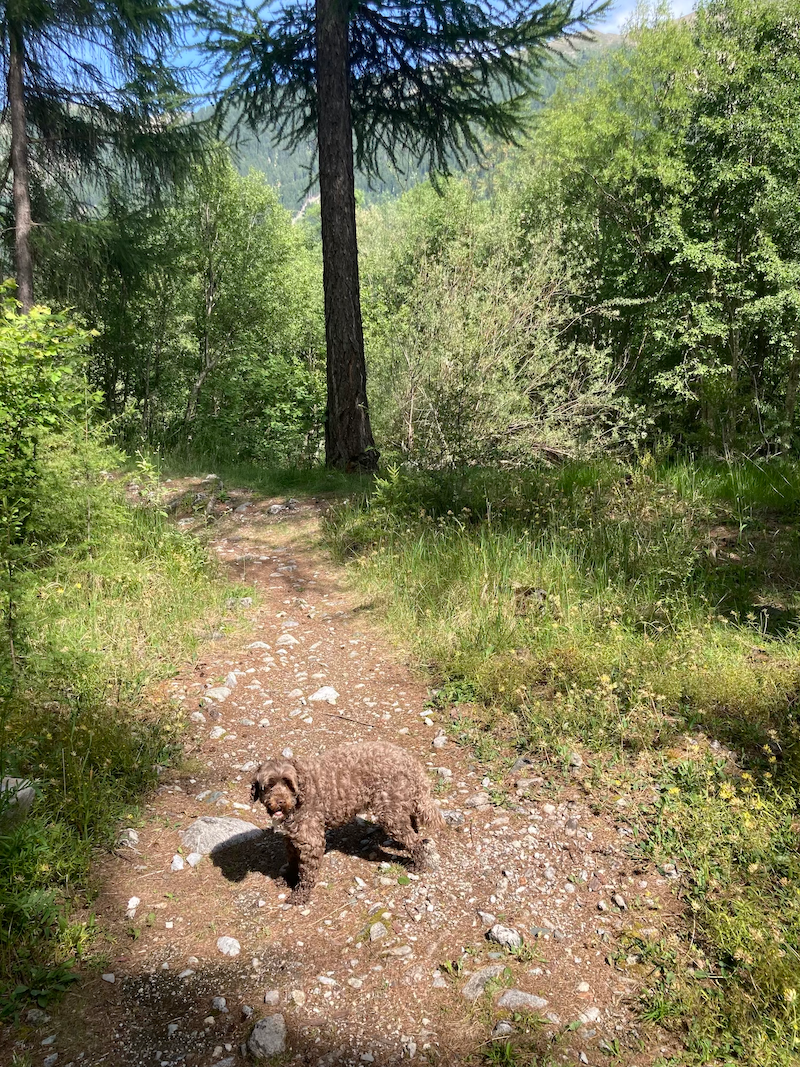
    I’m looking out at a mountain whose name I should know but do not; dark green fir trees line its side, pools and patches of snow and ice dot its peak. The last sunlight of the day turns the dark rock into a warm greenish brown. I’m in an old house in a small village in the South East of Switzerland. I’m here for a week of quiet with my mother and our dog. When I arrived, I was tense. I’m still tense now, only a little less. I’ve been thinking of this passage from Pema Chödrön:

    You’re the only one who knows when you’re using things to protect yourself and keep your ego together and when you’re opening and letting things fall apart, letting the world come as it is – working with it rather than struggling against it. You’re the only one who knows.

    In her memoir The Argonauts writer Maggie Nelson quotes Chödrön’s entire passage above before adding, with a sigh: ‘and sometimes, even you don’t know.’ It’s hard, confusing work, being a feeling human in the world. But I think this work of discernment is called for right now. Not because now is an easy time to practice it. But because being willing to let the world come as it is always increases my compassion. So: Am I being defensive, holding on to my favorite version of the truth, or do I soften, accepting that there’s much I don’t know? I’m the only one who knows.

    If we can feel the difference at all, I think we can feel it inside our bodies: ‘these soft houses in which we live and in which we move and from which we can never migrate, except by dying,’ as poet and essayist Kei Miller says. There’s something to know here, in those minutes and hours and days and years before our last migration.

    I’ve had Pema Chödrön’s quote taped above my various writing desks for over a decade. Nowhere do I work harder at keeping my ego together than in my writing. For years I thought Chödrön was only talking to her students, but no. The Tibetan Buddhist nun who was born 88 years ago in New York as Deirdre Blomfield-Brown is also addressing herself in this passage. Chödrön may have been a disciple of Chögyam Trungpa Rinpoche half her life, she may have meditated and practiced for decades, and yet she is also, still, trying to know the difference between protecting herself and letting things fall apart, letting the world come as it is. I take some comfort in that.

    Not afraid of things falling apart: the dog. Photo: Lena Tichy

    Letting the world come as it is might seem like a terrifying suggestion to some, so here’s a slightly more concrete exercise for when your head is spinning: Be still. Quietly to yourself or out loud, name something you can see, something you smell, something you can hear and something you can touch. Repeat as often as necessary.

    This Thursday, on June 19, Jupiter squares Neptune for the first time in twelve years. As much as we might try to work with the world rather than struggle against it, it might be hard to clearly see our own motives in the idealistic fog of this moment. Boundless compassion is as possible as hopelessness and burnout. People will proclaim they’ve found ‘the answer’ and people will try and sell you ‘the answer’. Remember that you’re the only one who knows. And if even you don’t know, give it a few days. Let the solstice on June 21 remind you that seasons pass. That you can make a wish – or not. Silence is just as alright.

    Sources

    Pema Chödrön: Comfortable with Uncertainty, Shambhala Publications, 2008

    Maggie Nelson: The Argonauts, Graywolf Press, 2015

    Kei Miller: Things I Have Withheld, Canongate, 2021

    This is an essay from my newsletter The Star Container, first published in June 2025. Subscribe or head to the archive here.

  • all that rushes in

    all that rushes in

    Although this is a newsletter partly about astrology, I’m often hesitant to bring up the planets and how they might influence us on a collective level. Because where is the line between a forecast and fearful future-tripping? The former can be helpful, like a kind of weather report, while the latter just feeds our anxiety, or worse, giving us the illusion that just because we know the weather forecast, we can also control the weather.

    Don’t get me wrong: I would love to control the metaphorical and practical weather of my life sometimes. My futile attempts at doing so are at least half the reason why I got into astrology in the first place. Since then, though, astrology has started to provide me with something more powerful alongside that: a growing awareness that I am, always, in communion with much larger forces. A sense that it’s never all up to me. So, here are a few words on what we will be in communion with for the next few months.

    In July of 2025, Saturn and Neptune will make a conjunction in the sign of Aries. This will be the first of two such meetings. While this first conjunction in July 2025 won’t be completely exact, the second one, in February 2026, will be. These slow-moving planets meet roughly every 36 years, always in a different sign. These are the only two Saturn-Neptune conjunctions in Aries we will experience in our lifetime. Because they are so rare, these outer-planet meetings always signpost deep societal and political changes.

    While Saturn rules boundaries, structures and reality, Neptune rules ideals, dreams and formlessness. One is solid stone, concrete and touchable, the other is gas, invisible and everywhere. When they meet in the skies, it can often manifest as the collapse of something we thought was solid and real.

    It is easy in hindsight to see how, for example, German rock musician Klaus Meine would think of the lyrics to ‘Winds of Change’ as he sat in Moscow’s Gorki Park in August of 1989. There was something in the air and he felt it: a thawing, a yearning for unification and peace. Just three months later, as Saturn and Neptune met each other in Capricorn in November 1989, the Berlin Wall fell, leading to the dissolution of the Soviet Union, a political structure that had existed for almost seven decades.

    ‘Winds of Change’ by Scorpions wasn’t released until January 1991 but this song, more than any other, became the soundtrack for the fall of the Berlin Wall and the end of the Cold War. Something as ethereal as music (associated with Neptune) can play a crucial role in the restructuring of the geopolitical reality (Saturn) of an entire generation of people.

    36 years on, we are coming to a new chapter in this cycle. What will it bring?

    Paradoxically, loss of faith is as common under a Saturn-Neptune conjunction as finding a new faith/dream/ideal to believe in. The unifying thread is Neptune’s mighty ocean tide flooding Saturn’s rigid need for control, order and stability. This is not to say order or stability are bad: We need those qualities to give a structure to our reality. It’s only if we get too rigid, if we start believing that everything must always be this way that a Saturn-Neptune conjunction will dissolve that notion, like an incoming wave washing down a sand castle. You have been living in one kind of reality, the conjunction seems to say, and now the time has come to experience a different kind.

    Considering the technological groundwork that’s been laid in the last decades, I also expect the line between reality and fantasy (or fake) to be erased completely under this upcoming conjunction. In the months and years to come, we will be asked to develop new muscles and instincts for discernment (Saturn) of images and movies (Neptune) and change our paradigm of who and what counts as real.

    Because Aries is a sign concerned with fighting and war, I expect the upcoming Saturn-Neptune conjunction to be not quite as gentle as a small wave. Perhaps, instead, what we will see is both more irresponsible, impulsive leadership (not naming names here) vis-à-vis deeply inspired and courageous leadership. We will see both more persecution of people because of their faith, and people fighting of what they believe in with their whole hearts, sacrificing everything for their ideals. 

    The question I’m turning over in my mind is how to be present for all of that: all that crumbles and collapses, all that rushes in. I come back to surrender, receptivity. I try to remember that, even as I think I’m doing things, I am always also, invisibly, being done to, shaped by uncountable currents we sometimes call ‘history’ when they reveal themselves, when they take form.

    You might wonder why I bring up all this astrological weather of July when it’s not even June yet. I do this because I am quite certain these energies are already making themselves felt. Seven days ago, Saturn joined Neptune in the earliest degrees of Aries, slowly inching closer to their first conjunction. In other words: the weather change has begun. Why not watch the sky for a bit? If only to remind yourself that you are part of something larger, quite likely infinite. And so beautifully mysterious.

    This is an essay from my newsletter The Star Container, first published in June 2025. Subscribe or head to the archive here.

  • accepting the unacceptable

    accepting the unacceptable

    For a long time, I misunderstood the nature of acceptance. I believed it implied consent, that, if I accepted something, I was automatically saying it’s okay.

    I don’t believe that anymore. I think acceptance can be a powerful doorway to change, if we let it. I say this as the people of Palestine are being slaughtered and famished by the State of Israel. So many have died already without even the dignity of a burial. So many might never be found underneath the rubble of Gaza.

    For a long time, I couldn’t accept that I now belong to a generation of people who are watching a genocide on live TV. No no no, I kept thinking, all the while remembering that the Srebrenica massacre or the genocide against the Tutsi in Rwanda also happened before an international audience, with no intervention to stop the unimaginable violence.

    So, I’ve been trying, day after day, to accept the unacceptable.

    There is something inside acceptance that is intimately tied to leaving behind naïve ideas of good and evil. We are asked to make a leap and say, yes, humans truly are capable of such acts. I wish it weren’t so, but it is. I’m human too. Where does that leave me?

    I want to say: it leaves me resisting. It leaves me a fiercer advocate for peace and liberation. It leaves me tender and often frightened. I want to say: there are perhaps no words yet for where it leaves me, where it leaves all of us.

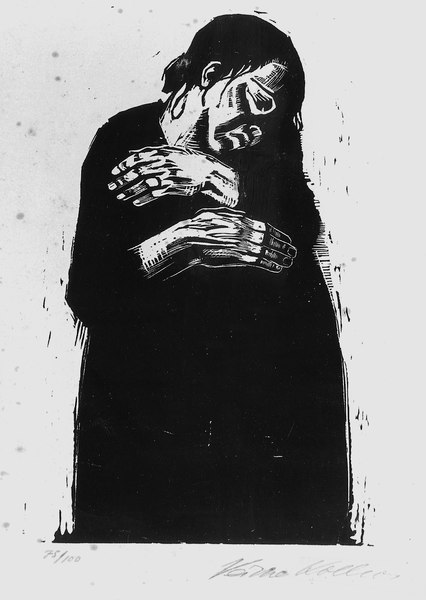
    I’ve chosen a woodcut from German artist Käthe Kollwitz (1867 -1945) to illustrate all this because she expresses this pain of being human so well. Kollwitz’ own son, Peter, didn’t survive the battlefields of World War I. Despite this loss, Kollwitz didn’t join in the growing pro-war movement forming in Germany in the early 1920s. Instead, using the visual language from war-propaganda, she created a series of anti-war posters. A woodcut to say: remember how fragile we are. In the years to come, Kollwitz would witness Germany’s plunge into fascism and the start of another World War. She couldn’t stop those horrors. But in her careful black lines we see a woman’s raw grief, something no blind desire for revenge or fascist regime can ever touch. We see an artist say I am paying attention.

    Today, there is a Full Moon in Scorpio. Of all the twelve signs, Scorpio is the one most associated with death and rebirth. And although every full moon brings with it a sense of release, culmination or intensity, if it’s in Scorpio, you cannot miss it. This is a moment of catharsis, letting go. Maybe for you personally, maybe for someone else. It is as good a time as any to practice accepting the unacceptable, to face whatever it is you think you cannot face. Look at it. Let yourself grieve. Let yourself be changed by what you see.

    This is an essay from my newsletter The Star Container, first published in May 2025. Subscribe or head to the archive here.