Tag: birds

  • our ruins, their songs

    our ruins, their songs

    There is a poem written by the Iraqi-American poet Dunya Mikhail that has been following me around. I first read it in a workshop with the Irish poet Pádraig Ó Tuama last year and it traveled all the way home with me, not leaving my head. It’s title, stark and descriptive, is: ‘This Poem Will Not Save You’. Mikhail lists, with empathy and clarity, all the ways in which her poem will fail to prevent tragedy, death and heartbreak. The phrase ‘I’m sorry’ is repeated three times in the poem’s fifty-three lines. The poem ends like this:

    I don’t know why the birds
    sing
    during their crossings
    over our ruins.
    Their songs will not save us,
    although, in the chilliest times,
    they keep us warm,
    and when we need to touch the soul
    to know it’s not dead
    their songs
    give us that touch.

    Take a moment. Read those lines out loud. Notice how the line breaks and commas urge you on at ‘us’, ‘times’ and ‘warm’ and how, in the lines that follow, you are made to pause at the words ‘soul’, ‘dead’, ‘songs’ and ‘touch’. I say all this to remind you that your own body is also part of the poem; that you have song in you, too. For the longest time in human history, poetry was only spoken, passed on through music and speech. Birds, signing for their own pleasure, gave us rhymes, gave us poems. To write a poem is to express gratitude for that ancient gift.

    Whereas Mikhail addresses an unspecified ‘you’ for most of the poem, she switches to an ‘us’ and a ‘we’ in the final lines. Because I am in some ways quite a self-centered person, it took me a long time to see that Mikhail’s ‘we’ is not necessarily about me, at all. The language here takes you right into a war zone (‘their crossings over our ruins. / Their songs will not save us’) and I have never lived in one. I have never known that kind of despair, or known ruins like that.

    Still, I do know loss and sorrow, on another scale, in other contexts. And I believe Mikhail is being generous by writing a poem for her people (or so I guess) and yet also offering it to a larger ‘we’, knowing that despair can take many forms, that all our lives are eventually touched by loss.

    The genocide carried out against the Palestinian people in Gaza is in its third year. Although much has been written about the horrendous 7 October attacks by Hamas there is, still, next to no political support for the hundreds of thousands of innocent people being starved and killed at the hands of the State of Israel. And while the recent decision of the Israeli government to introduce a death penalty for Palestinians was widely condemned, it also, crucially, did not seem to have any consequences for Israeli leadership.

    What is unfolding in Gaza is untouchable for me, in that I cannot imagine it. But I believe the people living through those horrors. I believe their voices must be heard, I believe their truth must be written and sung and shouted from the rooftops.

    Coastal Lines Press is a publishing collective founded by people who are living and surviving in Gaza. The project was initiated last year by Palestinian writer, poet and translator Shahd Alnaami. Shahd hadn’t been writing before the genocide, but when she lost her closest friend Eman in Israel’s war on Gaza in December 2023, she began to express herself on the page. And soon, others joined her. You can buy Shahd’s writing, and that of many other Palestinians, in the form of digital zines (which you can then print yourself). Each zine you buy directly supports the artist who created it.

    ‘Hope, however fragile, is an act of resistance,’ Shahd writes. I believe reading and sharing her words is part of that resistance too.

    There is a Full Moon in Libra on April 2. In that relationship-minded sign, Full Moons can sometimes be quite lovely, though I’m not expecting this one to be so smooth. The Sun and Moon are both in a square to Jupiter, loud, and demanding to be seen. Small adjustments will not do. But if it’s a shake-up you’re after, this Full Moon may just have it and put you back in touch with desires you have long neglected. Incidentally, this week is a great moment for reading poetry, too. It’s a moment to read a poem out loud and see how it lands in your body as well as your heart.

    Sources and further reading:

    ‘My Poem Will Not Save You’ by Dunya Mikhail is part of the collection In Her Feminine Sign, 2019, New Directions Publishing Corp.

    A portrait of Coastal Lines Press in The New Arab

    Shahd Alnaami’s personal website


    This is an essay from my newsletter The Star Container, first published in April 2026. Subscribe or head to the archive here.
  • after mystery, amazement

    after mystery, amazement

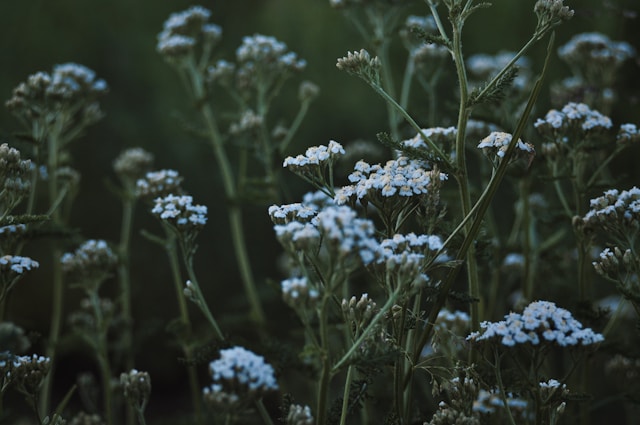
    Today, weary from sitting and staring at my screen for hours, I decided to visit a friend I haven’t seen since last year: yarrow (“Schafgarbe” in German). She grows in the forest near my house, up on the hill, by the water reservoir, on a narrow strip of unremarkable grass. I bent down to the ground to look for her delicate shape. Perhaps I’m just too early, I thought. It’s February, after all.

    But there she was, pushed close to the cold muddy earth, partly shielded by wet brown leaves: this common yarrow had made it through the winter. She looked pale but still like herself.

    I first met her about three years ago, in a community garden in Bern. It was August and she grew everywhere, though I would not have known that. One of the gardeners showed me how to spot her fern-like leaves, whose shape might remind you of a river delta, ice crystals or a drag queen’s eyelashes, depending on your frame of reference. I held a single long leaf in my hand, smelled it and then ate it, because the gardener told me to. I found that I liked eating that plant a lot. This strange taste of grass and pepper with a hint of liquorice, this ‘other’, irresistible.

    ‘The mystery was gone but the amazement was just starting,’ Andy Warhol once wrote. After I learned yarrow’s names, I grew amazed at her presence in the world. Her dried stalks have been thrown for thousands of years by Chinese shamans for divination with the I Ching. Her Latin name, Achillea, comes from Achilles who, according to Greek mythology, used yarrow to treat the battle wounds of his soldiers. She is medicine and has been used as such for thousands of years, both in Europe and by several Native American nations. Starlings pluck her stems to build their nests.

    She is not picky about where she shows up. I have met her on the edge of football fields, parking lots and in the middle of long-neglected gardens. The reason I’m writing about her now is partly because I hope you’ll meet her on one of your next walks and partly because I wonder what your own yarrow might be. What amazes you? What is your portal to the more-than-human world? It might be a tree, or a mountain. It might be a river, or many rivers. It might be birds or your cat. It might be the moon or the wind. It might be something growing in your backyard that has waited, all your life, to start a conversation with you.

    detailed photo of a yarrow plant with pink and white petals against a grey background
    Achillea Millefolium, or yarrow. Photo by Josef Hanel, taken around 1925. Public Domain

    A lot of people have told me in recent weeks that they cannot imagine things getting any worse than they are now. And yet. I had this sense that each person I spoke to also had a quiet knowing in their bones. Some truth humming underneath all the noise: things will get worse. But how will we cope?

    I certainly don’t know how. But perhaps the ‘not knowing’ is the point: There are things we can only discover about ourselves in a moment of crisis, like our ancestors did in the centuries before this one.

    February brings us, among many other things, a Lunar Eclipse in Aquarius (on the 17th) and the only exact conjunction between Saturn and Neptune in Aries (on the 20th). It is, in my humble opinion as an astrologer, one of the most difficult, confusing and surreal months of 2026.

    February will likely confront us with a further loss of order and the irreversible breaking down of structures both metaphorical and literal. Back in June of 2025 I first wrote about this conjunction (which occurs roughly every 35 years), naming some of the themes associated with it: the erosion of boundaries, the melting down of certainties, and yes, irresponsible leadership.

    Expect bad decisions to be made fast. Expect some of those bad decisions to be your own and forgive yourself. Whatever happens this month, don’t wind yourself up trying to get ‘a clear picture’ of anything. That is for later.

    If you can, go outside. If nothing else works, just stare at a wall for a while. But most of all, trust that whatever lies ahead will meet us where we are. Not our perfect selves, not the versions of us who have finally conquered our to-do lists. It will be just you and me, in the messy middle of our lives, living through extraordinary times. May we know that we are not doing this alone. May we greet our friends and prepare our gardens for spring, amidst everything.


    This is an essay from my newsletter The Star Container, first published in February 2026. Subscribe or head to the archive here.
  • singing in the dark

    singing in the dark

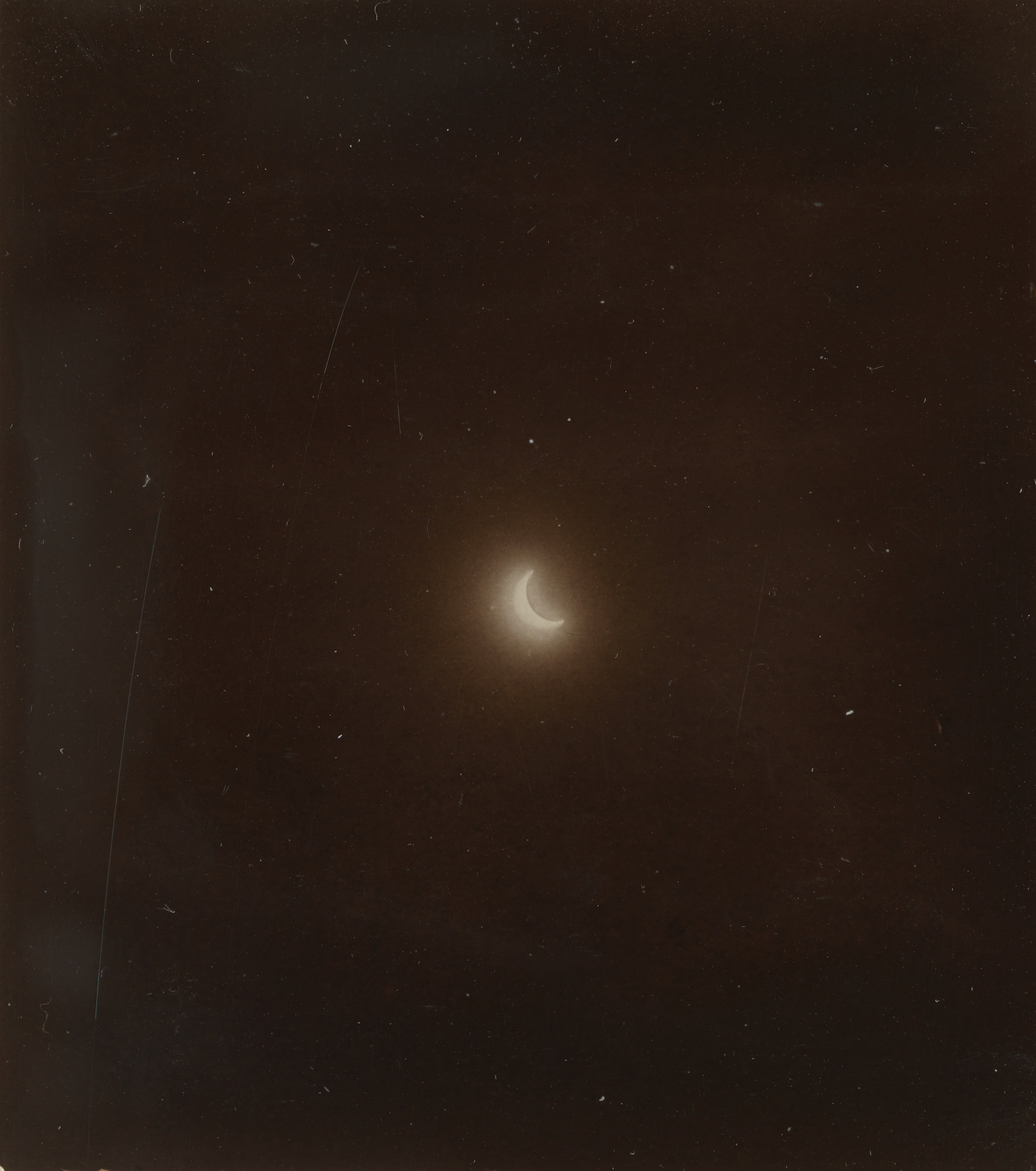
    March is closing out, how are you? Rattled, tired, or generally okay? No matter the emotional temperature, the skies gave us one more gift yesterday: A Partial Solar Eclipse in the sign of Aries, visible in the Northern Hemisphere.

    Eclipses used to be feared in ancient times: they were seen as a bad omen. It’s understandable our ancestors would think this, given that watching a Solar Eclipse can rob you of your eyesight and life on earth depends on the light of the sun (and the moon, of course). If we lose this light, even for just a couple of minutes, in the middle of the day, things start to feel very strange.

    For over a century now, citizen scientists have studied the behavior of animals, especially birds, during Eclipses. They found that, although a certain silence descends over nature during a Solar Eclipse, the Sparrow, Goldfinch and Thrush keep on singing as the moon travels before the sun and starts to block its light. Even at totality, birdsong continues. There are also other species, such as Swifts or red-winged Blackbirds who, instead of singing, completely abandon whatever foraging mission they were on and return to their nests. Over and over, this kind of behavior has been described as ‘confused’.

    But nature rarely is. Every time we pronounce some animal or plant behavior confused or strange, we end up finding a few decades later that the strangeness was underpinned by more-than-human wisdom and intelligence. We’re just playing catch-up.

    When the sun is eclipsed, the birds are singing in the dark. Perhaps they do it because the sudden darkness feels like the hour before dawn. Perhaps they have a wiser reason than that. But they sing. And if they don’t sing, they return to their nests, close their bird-eyes and huddle. Perhaps they do it because the darkness feels like the night. Perhaps, perhaps. We also know most of these birds will experience a Solar Eclipse only once in their brief lives, unlike humans. That must be strange.

    So, what about us? I think both huddling in whatever nest you have made for yourself or breaking out in song are great things to do during an Eclipse. The days surrounding a Lunar and Solar Eclipse are powerful, often bordering on overwhelming. Instead of a regular Full Moon and New Moon, March gave us a Lunar Eclipse in Virgo on the 13th and this Aries Solar Eclipse on the 29th. The next time we’ll get a pair of Eclipses like that is September 2025.

    Eclipses are a good time for doing a little less of everything and really trusting your gut. And although this newsletter seems one day late, I maintain this advice, including the huddling and singing, can easily be taken into the new week and the first days of April. If you feel like it, maybe you also want to look back. What started to appear in your life around the 20th of April 2023?

    This was the date of the first Solar Eclipse in Aries, lighting up a new place in our individual birth charts. For the last two years, several Eclipses have worked this terrain in our psyche and our lives, until yesterday, when the final Solar Eclipse in Aries closed out the cycle (and the month of March!). We won’t have another eclipse in Aries until 2032, which explains why astrologers make such a big deal of these things.

    So, here are some Aries Eclipse questions:

    How have you learned to honour your individuality and your own freedom since April 2023? Has someone or something entered your life and acted as a teacher on this front?

    Where in your life have you become more courageous, asking for forgiveness (if needed!) rather than permission?

    What have the last one-and a half years taught you about trusting your first impulses?

    This might be in your one-on-one relationships, your public roles, your work, with your family, your health, your own mind or your creative work and self-expression.

    The sun’s and moon’s light will continue to disappear on us, in regular intervals. And we need not fear it. Instead, we can use these moments to illuminate the progress we made, the ways we changed and grew. How we fought for what’s good and reached for what we yearned.

    This is an essay from my newsletter The Star Container, first published in March 2025. Subscribe or head to the archive here.