Author: Lena Tichy

  • after mystery, amazement

    after mystery, amazement

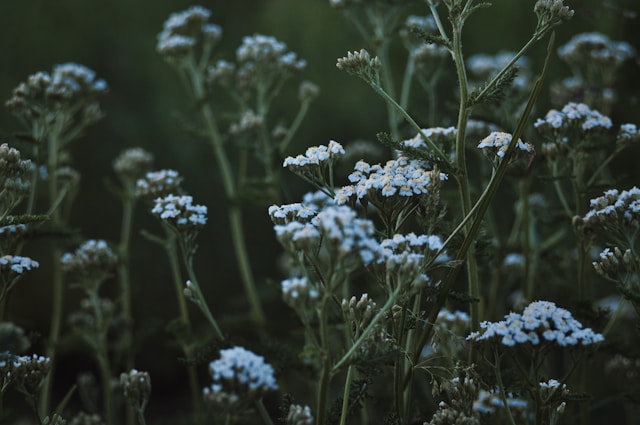
    Today, weary from sitting and staring at my screen for hours, I decided to visit a friend I haven’t seen since last year: yarrow (“Schafgarbe” in German). She grows in the forest near my house, up on the hill, by the water reservoir, on a narrow strip of unremarkable grass. I bent down to the ground to look for her delicate shape. Perhaps I’m just too early, I thought. It’s February, after all.

    But there she was, pushed close to the cold muddy earth, partly shielded by wet brown leaves: this common yarrow had made it through the winter. She looked pale but still like herself.

    I first met her about three years ago, in a community garden in Bern. It was August and she grew everywhere, though I would not have known that. One of the gardeners showed me how to spot her fern-like leaves, whose shape might remind you of a river delta, ice crystals or a drag queen’s eyelashes, depending on your frame of reference. I held a single long leaf in my hand, smelled it and then ate it, because the gardener told me to. I found that I liked eating that plant a lot. This strange taste of grass and pepper with a hint of liquorice, this ‘other’, irresistible.

    ‘The mystery was gone but the amazement was just starting,’ Andy Warhol once wrote. After I learned yarrow’s names, I grew amazed at her presence in the world. Her dried stalks have been thrown for thousands of years by Chinese shamans for divination with the I Ching. Her Latin name, Achillea, comes from Achilles who, according to Greek mythology, used yarrow to treat the battle wounds of his soldiers. She is medicine and has been used as such for thousands of years, both in Europe and by several Native American nations. Starlings pluck her stems to build their nests.

    She is not picky about where she shows up. I have met her on the edge of football fields, parking lots and in the middle of long-neglected gardens. The reason I’m writing about her now is partly because I hope you’ll meet her on one of your next walks and partly because I wonder what your own yarrow might be. What amazes you? What is your portal to the more-than-human world? It might be a tree, or a mountain. It might be a river, or many rivers. It might be birds or your cat. It might be the moon or the wind. It might be something growing in your backyard that has waited, all your life, to start a conversation with you.

    detailed photo of a yarrow plant with pink and white petals against a grey background
    Achillea Millefolium, or yarrow. Photo by Josef Hanel, taken around 1925. Public Domain

    A lot of people have told me in recent weeks that they cannot imagine things getting any worse than they are now. And yet. I had this sense that each person I spoke to also had a quiet knowing in their bones. Some truth humming underneath all the noise: things will get worse. But how will we cope?

    I certainly don’t know how. But perhaps the ‘not knowing’ is the point: There are things we can only discover about ourselves in a moment of crisis, like our ancestors did in the centuries before this one.

    February brings us, among many other things, a Lunar Eclipse in Aquarius (on the 17th) and the only exact conjunction between Saturn and Neptune in Aries (on the 20th). It is, in my humble opinion as an astrologer, one of the most difficult, confusing and surreal months of 2026.

    February will likely confront us with a further loss of order and the irreversible breaking down of structures both metaphorical and literal. Back in June of 2025 I first wrote about this conjunction (which occurs roughly every 35 years), naming some of the themes associated with it: the erosion of boundaries, the melting down of certainties, and yes, irresponsible leadership.

    Expect bad decisions to be made fast. Expect some of those bad decisions to be your own and forgive yourself. Whatever happens this month, don’t wind yourself up trying to get ‘a clear picture’ of anything. That is for later.

    If you can, go outside. If nothing else works, just stare at a wall for a while. But most of all, trust that whatever lies ahead will meet us where we are. Not our perfect selves, not the versions of us who have finally conquered our to-do lists. It will be just you and me, in the messy middle of our lives, living through extraordinary times. May we know that we are not doing this alone. May we greet our friends and prepare our gardens for spring, amidst everything.


    This is an essay from my newsletter The Star Container, first published in February 2026. Subscribe or head to the archive here.
  • something endangered, something extinct

    something endangered, something extinct

    The day before Christmas last year, my nearly six-year-old nephew announced that he had prepared a surprise for everyone. We were about to start dinner when it was my turn to be surprised. ‘Close your eyes and pick something,’ he said, holding a small carton box. I closed my eyes and fished out a lime green toy car. ‘Aha,’ my nephew said, and told me to follow him upstairs to his room.

    There, he opened his closet, revealing a shelf full of animal figures, some large, some small. ‘You picked the car from the box, that means you can now have one of my animals,’ he explained. I looked at him for a moment, wondering if he really meant it. ‘I mean it,’ he said. ‘Which one do you want?’

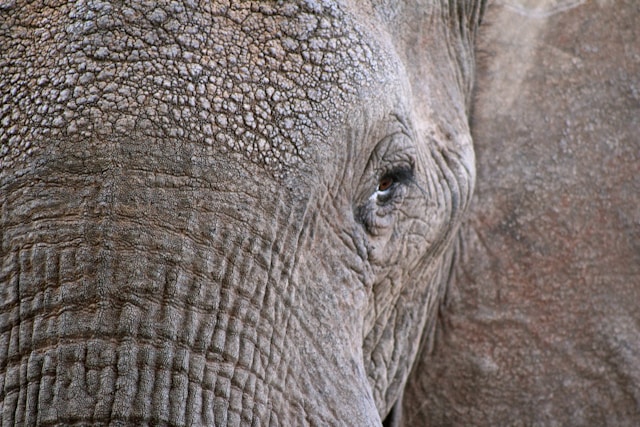
    ‘I think I need a strong animal,’ I said, picturing the year ahead in my mind. My nephew is a passionate collector of Pokémon cards and thus deeply understands the mechanics of danger, protection and magic. ‘Take the elephant and the mammoth’, he said. ‘They’re the strongest ones.’ He handed me a plastic elephant the size of a large pillar candle and a mammoth that just about fit in the palm of my hand. I lightly pushed my fingertips into its sharp tusks.

    ‘You mean I can take them both home with me?’, I asked. ‘Yeah,’ my nephew said. ‘For as long as you need’.

    The elephant and the mammoth are now placed on the sideboard in my hallway and one of the first things I see when I come home. In some mysterious way, they remind me that this year calls for a very different kind of logic. You might call it dream logic or childhood logic. Conventional logic and pure rationality will not entirely cut it for the months ahead, I think. Not because 2026 is not a serious year; it is deeply serious, and dangerous too. But you already knew that. And when you’ve felt all the panic and outrage you can feel at the state of the world, what is left? What feeds your soul?

    It might be something endangered, something extinct. Most likely, it won’t be grand, loud or shiny (unless we’re talking about real elephants, of course). It might have lived for a long time in a box in your attic, waiting to be found again.

    As we move into the second half of January, you might notice a rising of the tension within and without. I say this because all of the personal planets – Venus, Mercury, the Sun and then Mars – will form a conjunction to Pluto in the early degrees of Aquarius over the next nine days. It’s a very distinct all-or-nothing kind of energy that can kick up our survival mechanisms and make us obsessive in our thinking. But on a personal, psychological level, Pluto also may unearth something that has tormented us for a long time and finally reveal its true unscary shape and size.

    In ‘Letters to a Young Poet’, Rainer Maria Rilke wrote: ‘Perhaps all the dragons in our lives are princesses who are only waiting to see us act, just once, with beauty and courage. Perhaps everything that frightens us is, in its deepest essence, something helpless that wants our love.’

    It’s no small feat, to confront the things that frighten us. But the next couple of days invite us to do so. So here’s to trying, to staying with it. And to being surprised at what we dig up.


    This is an essay from my newsletter The Star Container, first published in January 2026. Subscribe or head to the archive here.

  • an experiment in being wrong

    an experiment in being wrong

    The main reason I started writing this newsletter at the beginning of 2025 is that I wanted to confront a deep-seated fear of mine: I’m scared of sharing my point of view, my way of seeing the world. Not necessarily in conversation (as my friends can attest) but certainly in writing. I always worry that I have not chosen the perfect words, that someone will find I’m inconsistent or, god forbid, wrong.

    In some ways, The Star Container is an experiment in being wrong twice a month. It’s an experiment in imperfectionism. I’m not building a cathedral, I’m just pottering around in the garden: a heap of earth here, a heap of earth there. Sometimes a flower pushes up through the mud.

    In sitting down and gathering my thoughts for these pieces, I’ve learned to trust myself and my words a little more. Thank you for being a part of that, dear reader. I hope that some of what I wrote has helped you to create your own experiments for a more imperfect life.

    And speaking of design: January of 2026, especially the first half, is a really good time to create a few good routines for yourself: take that daily dose of magnesium, have that weekly phone call with your best friend. If you hate routines, maybe clear out some cupboards. Why? Because almost all the planets are in Capricorn and Capricorn loves a to-do list, a plan, and a structure.

    So, lean into the structures of your life. Update them where needed. And know that, come February, all your great routines (and mine) might fly out the window. But more on that in the next newsletter.

    I’ll end with something for your ears: Back in November, musician Daniel Imhof asked me to collaborate on a track for a new album called ‘we’ by the band ali dada. The band had asked various musicians to come together and record songs for this painful, nonsensical moment we find ourselves in. They call their genre ‘hope punk’, which, it turns out, is exactly my thing. I wrote a fairy tale about a pack of wolves and recorded it on my phone one dark evening after work and Daniel added a wintery, gorgeous soundscape. Our track is called ‘wolf mother’. You can listen to and buy the whole album here on Bandcamp. I’m looking forward to hearing your thoughts!

    Until then, stay warm (or cool, if you’re in the Southern Hemisphere) and have a Happy Most Imperfect And Yet Beautiful New Year.


    This is an essay from my newsletter The Star Container, first published in late December 2025. Subscribe or head to the archive here.